
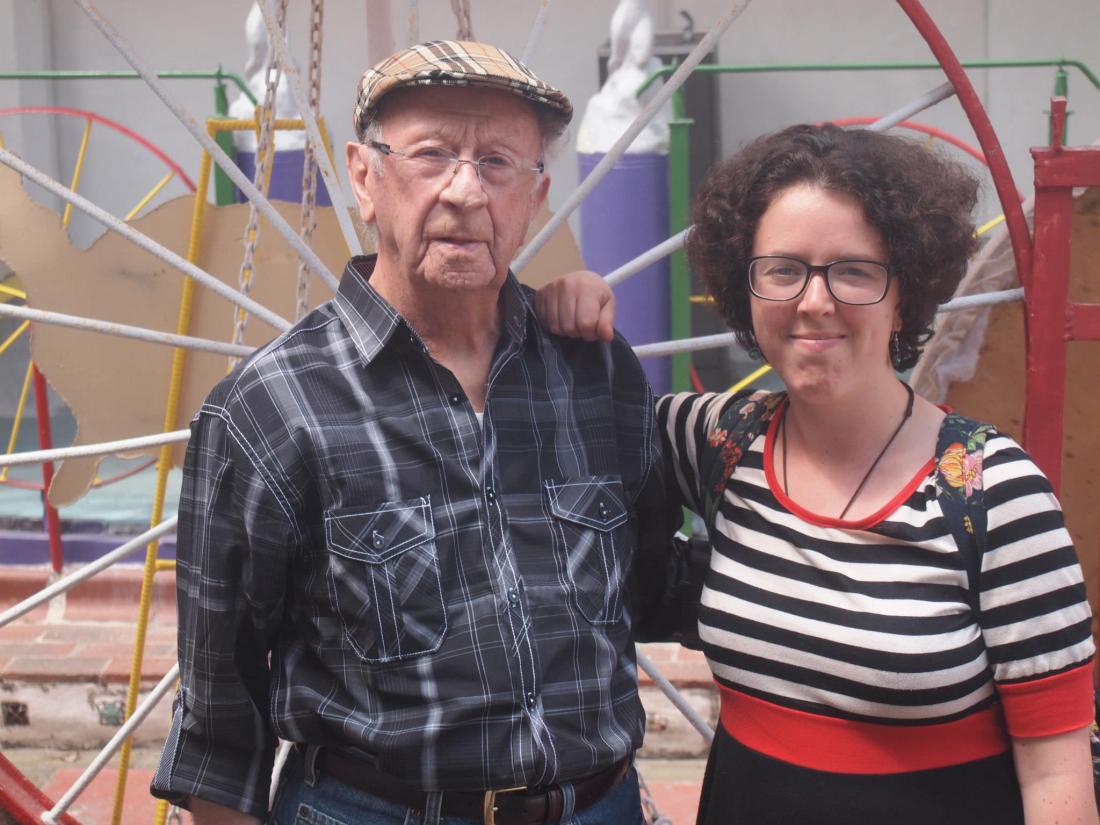
Written by Lev Fayyershteyn at age 89, December 2016. Deceased: January 2017.
Translated by his granddaughter at age 33, August 2020. Location: South Korea.
Soviet Union Departure Date: May 29, 1991.
Translator’s Note:
My mother’s father Lev Fayyershteyn was born on June 28, 1927 in Tyumen, Russia and had barely joined the army when World War II ended. While in the army, he was persuaded to become a Communist Party member, which over time provided him and our family with more benefits and privileges than most other families. Throughout this story, it is impossible not to notice certain indicators of privilege, such as owning a car and the ability to travel outside of Russia.
Despite this, as a Jew, he and others faced lifelong anti-Semitism and discrimination in the Soviet Russian socio-political climate. Intermarrying with ethnic Russians transferred this discrimination to the family, which happened to my grandmothers on both sides. As explained here, Soviet Jews began emigrating in waves from the early 1970s, but it wasn’t until the late 1980s and early 1990s that this demographic really started leaving en masse. Of the 1.6 million Jews that left the Soviet Union between 1989 and 2006, nearly 2/3 went to Israel and around 325,000 went to the United States. Our family was part of this latter group, a very specific American immigrant demographic, formally given refugee status.
When we left, I was a few weeks away from turning four years old. I grew up in the United States as a bilingual Russian and English speaker, but I was never part of a Russian or Jewish community outside of my own family. My other three grandparents passed away in the United States when I was nine and twelve, but Grandpa Lev outlived everyone and managed to leave this short record of his and our experience. I have the feeling that if he had started writing earlier, or had a bit more time with us, he could have expressed much more. I am grateful for what he did leave and for my ability to read and translate the Russian to English. If we don’t know – of if we learn and then forget – our ancestors’ history, then we can never gain strength from their wisdom.
DEPARTURE
A Pan Am Moscow-New York flight, specially organized for emigrants from the USSR.[1]
It was calm and cozy inside the plane’s cabin. The pleasant cool air, the faint voices of a few passengers and even the odd cry from one of the many children couldn’t prevent me from drifting off to sleep, which was strange for me, as I was afraid of flying. I was under enormous physical and mental strain from the chaos of the last days before the flight, spending nearly 20 hours without sleep and food in Sheremetyevo Airport, saying goodbye to relatives and friends, and enduring humiliating treatment towards emigrants, including myself. I was as yet unable to come to terms with my own feelings and attitude to what had happened to me and my family. I felt as if I was returning from a business trip or a vacation back home to Moscow, and that in a few hours I would be with loved ones and sink back into my familiar existence.
Only the occasional English coming from the stewardesses kept bringing me back to a kind of panic of which I was not yet even fully conscious. To my right across the aisle sat a huge guy who reminded me of Tevye the Dairyman from the American film. [2] In front of him stood a stewardess, looking on in surprise and scorn as he knocked back yet another plastic cup of booze. Later on, he was taken aback at my refusal to drink with him for free.
Finally, I started coming to my senses at the sound of the passengers’ applause, a tradition confirming our plane’s landing at New York’s Kennedy Airport. All passengers were told to stay in their seats until the call to exit, and people mostly sat and waited patiently for the command, humbled and slightly frightened. Afterwards, we were led into a small room, shuffled around for no reason with our children and luggage. Judging by their accents, those in charge of all this nonsense were two Odessa Jewish women. [3] During this short time, one of them, fat and with tastelessly made-up lips and eyes, repeatedly shouted in her nasty voice that we weren’t in Russia anymore, and that for any misdeeds, she could get us kicked out of the building.
But everything eventually fell into place. The arrivals received their necessary documents and went out under the orders of this fat creature. My repeated requests to the second, no less nasty “lady,” to move faster with processing the documents for our family, as our plane would be taking off in minutes [4] were met with the same answer – everything would be ‘OK’ and the flight schedule wasn’t my business. However, my fears were soon confirmed, as their sluggishness forced us to grab our luggage within 10-15 minutes, take it to bag check, and run with our children and elderly from one terminal to another. On the way, this beast said that we were all idiots and that instead of flying to Atlanta, we should be flying to “our fucking mother.” As a Soviet emigrant, I was used to this kind of service, so I told her to “fuck off.” And yet we managed to take off, with a two-hour delay in schedule, that may or may not have been caused by our lateness. In the first few minutes in the cabin, I sat soaked in sweat from all the anxiety and running around, but the passage of time and the cool temperature did their job and I gradually began to settle down.
What happened? Why was I here with my many family members? Why and in the name of what did I completely cross out absolutely everything that was, and that which never was but could have been, in my 64 years of life? Is it possible to give a short answer to this and many other questions?
For a long time, from around the beginning of the 1970s, Jews had been actively fighting for permission to leave the USSR for Israel, where emigration was difficult but possible. [5] Naturally, most people were unable to leave, but the stream of emigrants grew and when Jews met, they would bring it up again and again.
In those years, mine and my family’s life continued its normal rhythm. Mara [my grandmother] and I were more or less satisfied with work, a comfortable family standard of living by Russian standards, and the question of leaving didn’t come up for us. But our friends started leaving, the first of whom was Rudman, who went to Israel in 1972. Friends, acquaintances and their children began sending letters from abroad. Several times me, Mara and the kids took the car out to visit neighboring countries during vacation, and I went on business and tourist trips to Poland, Bulgaria, Yugoslavia, Italy, etc. and gradually our eyes opened to the lives of people outside of Russia. We still didn’t know the reasons for the deep poverty, lawlessness and humiliation of our Socialist life. As we came face to face everyday with the consequences of these reasons, at home and at work we criticized Soviet rule and the Communists but in general it carried more of a satirical rather than an angry tone.
Six years prior to our departure, Mara had become a pensioner, and now our son was raising our grandson [my cousin, born 1980] and our daughter had gotten married and given birth to our granddaughter [me, born 1987]. In 1988, Mara and I stayed with some acquaintances in the USA [first trip to the USA]. The stream of people leaving grew and grew and an opportunity arose to get to America through Vienna and Rome. [6] Information from those who left told the story that those who emigrated, for better or for worse, managed to build their lives in Israel as in America. Thoughts of leaving also arose in our family, especially among our children. But not very seriously and only episodically.
When Gorbachev came to power in 1985, the talks slowed somewhat, and like millions of our fellow Russians, we believed him and decided on the possibility of cardinal changes in Russia within the coming years. But as time went on, negative information grew about past Party deeds and leaders, about the criminal role of the CPSU (Communist Party of the Soviet Union), the first spilt blood and casualties appeared in the far corners of the country, and it became more and more difficult to get groceries and clothes. Critical analysis of the past and present gave every reason to come to a fairly clear conclusion: the fate of the USSR depended on the preservation or the dissolution of the Party. While this gang was in power, there would be blood, there would be death, and there wouldn’t be any food, clothes, housing or even a semblance of normal human existence. This conclusion was confirmed by the events in Czechoslovakia, Poland, and Hungary.
In the USSR, this gang was not about to give up power, and with control of the army, the KGB, and its worth in the millions, it would continue to resist long and hard. I thought that the CPSU would eventually die out, but only after huge sacrifices by the people. And our people, who for seventy years were seduced into slavery, whose very humanity was choked out, who lost the meaning of hard work but were taught to get drunk, who were handed a “bright future” instead of a better tomorrow; our people, living in poverty up to their ears, in hunger, accustomed to huts and communal apartments that were unimaginable to civilized people, completely unable to imagine a normal human existence, for the above reasons still to a significant extent obeyed the orders of the Communist gangsters. There are many examples of this, including voting and referendums in the hinterlands of the country, in the Asian Republics. But the most telling in this sense were the televised show-congresses of the deputies of the USSR and the Russian Soviet Federative Socialist Republic.
It’s worth noting that there was practically nothing written in the Soviet press about the motives for the behavior of those who had disappeared, just as there was none for the apparatchiks still in power. Normally when we talk about those vying for power or those fighting to keep it, in civilized countries this is referring to people whose motivation for gaining power is ambition, a desire to glorify themselves, and for others it’s just everyday work. But major politicians are always to one extent or another financially secure, so the very existence of power as a position doesn’t carry with it much in the way of tangible material growth. Whether they get elected or not, they will keep living in the same comfort as before the election.
In the USSR, the situation was totally different. As soon as someone got any power, they immediately received a significant salary, a personal car, an apartment according to the standard, allowances, and free travel for special medical treatment. And the higher up the position was in the hierarchy of power, the bigger the benefits. As expected, losing this power meant immediately losing everything. For that reason, the desire to move up the ladder and – God forbid – the prospect of losing what one has gained makes the holder of this power a beast, a gangster, with no moral or ethical principles in his soul, ready to sell everything and everyone for a piece of the “fine sausage.” Considering also that for all those years of Socialist paradise, among the party-Soviet bosses there was practically never a single one that was educated, intelligent or capable of doing anything besides following the stupid or even criminal directives of the Politburo, then it is easy to imagine how hard they fought to maintain their power and how much strength was needed to wrestle that power away from them.
And so in the spring of 1988, the decision to leave finally ripened. Me and Mara completely understood that as a result of emigration, our lives wouldn’t exactly end, but they would get much worse, as learning a foreign language at our age was impossible. Especially for me, I knew for a fact that I was bad at languages, besides some basic phrases at the store or on public transport. After losing our friends in Russia, also due to age we would be unlikely to make new ones. So we would be left to live out our lives in loneliness, which is very difficult for a normal person. I was used to an active lifestyle, not sitting all day on the couch without people, TV, radio, or newspapers. But we had two children and two grandchildren, and we were obligated to give them all possibilities for a better life. In short, we couldn’t leave our children – that was out of the question, as there was nothing for us to do without them. By this time, we had already received ten questionnaires from our friend Victor Rudman in Israel: for me and Mara, for our son’s family, for our daughter’s family and for the parents of my son-in-law [my father and his parents]. But the idea of immigrating to America wouldn’t leave me, for a number of reasons including the fact that there would be no work for my son-in-law in Israel. I waited in line for two weeks at the American embassy for the preliminary questionnaires for immigrants, and after waiting another two weeks, I finally submitted them at the embassy in June 1989. During this time, there was hope for the Supreme Council to pass the “Law on Entry and Exit,” so we didn’t yet submit the questionnaires to the State Migration Service. [7]
Thirteen months went by and in July 1990, Mara went into town by chance and took a big yellow envelope out of the post office box, which had an invitation for an interview. The same day, our children and in-laws received analogue questionnaires. We were all invited for an interview on October 15, 1990. We already knew that an interview invitation almost always meant receiving refugee status. [8] Our chances to go to America increased significantly and we had a “small” dinner party at our dacha [9] to celebrate – we had all received refugee status. A month after the invitation, we submitted our questionnaires to the State Migration Service and Mara and I started learning English (our kids had already been studying for two years, with clear results). From January 1, 1991, I retired, received my pension, and fully dedicated myself to preparing our departure. We had to sell all four apartments, garages and the car, the crystal and bronze that was stupidly not allowed outside of the gulag, and winter clothes and furs that would not be useful where we were going: Atlanta, USA. [10] We also had to sell Mara’s valuables, as we could only leave with items valued up to 5,000 rubles. This stupid law was passed a long time ago, after which our lovely government already raised the price of gold and silver three times, yet the 5,000 ruble limit remained the same. The ring that Mara bought 10-15 years ago for 250-300 rubles would be valued at 10,000 – 15,000 rubles by the customs officer. Well, to hell with all of it, the valuables and the thiefs. They would hardly be worth anything in the USA, and Mara just wanted to keep them as a memory anyway.
It’s worth saying a few words about “Спейт – Москва.“ This organization took up some of the functions of the USA consulate in connection with emigration from the USSR to the USA. You were called into Спейт, where all of your information was checked on the computer and your flight date was scheduled. If you were going to use credit for your plane tickets through Спейт, then you signed some documents and also scheduled a date for a medical check-up (if you had syphilis or tuberculosis, in Russia you could buy a positive or negative diagnosis).
As the departure date grew closer, scheduled for May 29, anxiety grew in the family : it seemed that many things wouldn’t be solved in the remaining days, that we couldn’t pack everything, that the glass would break, that… But, as always happens in these situations, everything managed to work out: everything that needed to be sold was sold, additional necessities were bought for life in the USA (though to be honest, half of them were totally useless), things were packed up and weighed in exact accordance with aviation rules, friends agreed to drive us and our baggage to the airport.
And finally, it was the last evening with relatives and friends – buffet-style, as the apartment was completely cleared of furniture except for some stools borrowed from the neighbors. We said our forever goodbyes, and for some reason exchanged addresses, phone numbers, best wishes, etc. The following morning was our departure.
There were rumors that due to slow processing at customs, not all emigrants finished inspection on time, and apparently some planes took off with absent passengers. Because of this, I and another relative went to the Sheremetyevo Airport at noon, exactly 24 hours before our flight departure. I immediately found the waiting list for inspection and signed up under number 24. Eugene and I sat together until 10 that night, when our family members and those seeing us off started to arrive. One of them brought a fold-out bed where we put the grandchildren to sleep and a couple of chairs for the elderly, as Sheremetyevo had far fewer seats than were needed.
The staff were promptly doing their job. Yet another family arrived and received their document file, their flight tickets, signed the obligation-to-pay form (if they bought the tickets on credit) and moved towards the customs line. From our group, the first to go were the in-laws. They took my son-in-law’s mother’s earrings and rings, but for some reason left his father’s ancient watch with the three gold lids. Overall, their inspection went well. Next up was our daughter’s family [my parents and I]. Before inspection, around 11 or 12 at night, our son-in-law decided to double-check something in one of the bags and when he took his hand back out, his wedding ring had slipped off. He decided not to look for it. Filling out the customs declaration, he honestly wrote down everything including the ring and explained that to the customs officer. And what does this bitch do?
He says to my son-in-law: Either look for the ring now, or cross it off the declaration, but if I find it, I won’t let it through, as it’s not on the declaration form. My son-in-law was obviously not about to look for the ring in an anxious hurry. Finally, the customs officer used his instruments to look over the bag piece by piece, found the ring, and refused to allow it through with the other things. It was lucky that he didn’t just take the ring. However, while in the middle of looking for the ring, this blockhead also overlooked 10-15 silver accessories, which weren’t samples and so weren’t written on the declaration form, and which our daughter didn’t even count on transporting. They took all of our daughter’s diamond rings. Our son’s family had a fairly clean inspection, not counting the fact that they took almost all of his wife’s valuables.
Finally, it was our turn. The customs officer immediately refused to accept gold and silver products with diamonds, valuing them at 20,000 rubles each at a glance and he also wouldn’t accept my three-ruble coin-sized “Star of David” gold pendant on my necklace. Yet he let through an ancient Italian colored marble mosaic, which had been twice denied by the experts at the Ministry of Culture. In fact, this same expertise allowed through three Korin paintings, which speaks to the ministry’s competence. Everything described above took place under conditions that resembled urgent wartime evacuation before the enemy entered the city. Carefully repacking everything that the customs officer had thrown about before the inspection was virtually impossible, what with being rushed, surrounded by hurrying people, relatives and friends crying goodbye behind the gate, and the customers officer watching you like a hawk as though you were a potential criminal.
In her effort to somehow shove everything back into the bag and shut it, Mara managed to break the zipper that ran the length of the bag, which made it completely impossible to close. Totally soaked in sweat from the meaningless hurry and running around with four bags weighing 30 kilograms each, I tried to fix the zipper, but to no avail. The bag needed to be sewn up. At that moment, the customs officer sent me to the cashier to pay the extra duty fee for transporting works of art. When I came back, I noticed Mara was missing, but the customs officer said that she would be back in a minute and asked me to come to the personal inspection room (that is what they call the search room). Now I understood where Mara was. What in the world did I do to make him suspicious? Two customs officers led me to some kind of room and had me take off my jacket and pants and raise up my shirt. They combed through all my things, felt me up from head to toe, but found nothing except for the keys to our old apartment, which I immediately afterwards threw into the trash. Returning to our luggage stand, we somehow managed to shove everything into the bags. Then, after successfully checking our luggage, checking in to our flight, and going through passport control, we found ourselves in a neutral zone. The clock showed the time to be 6 a.m., May 29, 1991. That is how I spent 18 hours in the Sheremetyevo Airport. The flight wasn’t for another 6 hours. I was completely dead, as was our whole family and as were all the other emigrants who had gone through this customs hell.
At least in the waiting area, I could finally sit down after six hours on my feet before and during the inspection, eat in the buffet for the last time with soon-to-be useless rubles, and after resting a little, shaving in the bathroom. My granddaughter [me] in normal, familiar circumstances, was usually well-behaved, but here the overall anxiety and excitement even got to her and though she had slept during the night, she was asking for something and demanding attention. However, she calmed down and even managed to sleep in her mother’s arms for a couple of hours. Suddenly, it hit us – our son [my uncle] was turning 35 on this very day. Gathering all of our remaining rubles, we bought a couple of beers and sandwiches from the buffet and celebrated.
By our Russian standards, boarding the flight went smoothly, despite the inclinations of some of the emigrants to set up a line for some unknown reason. But these were the last little moments of this event.
[Fast forward to after the New York – Atlanta domestic flight]
In Atlanta, we were met by a group of very kind and considerate elderly volunteers. All that was left was loading up the car and another 25-30 minutes of travel and we arrived at our future residence. What awaited us? What would we have to overcome inside ourselves, getting used to a new life, new laws, habits, customs, basically everything that makes up everyday life? One thing was clear, that the famous Chinese proverb “Better to see something once, than to hear about it a thousand times” fully applied to us. Only, we had to exchange the word ”better“ with ”need.“
For us, this “need” had just begun.
Footnotes
[1] Pan Am flights between Moscow and New York had started a few years prior, in the late 1980s.
[2] Grandpa often made Jewish cultural references about people. From the Wikipedia page: “Tevya is a 1939 American Yiddish film, based on author Sholem Aleichem‘s stock character Tevye the Dairyman, also the subject of the 1964 musical Fiddler on the Roof. It was the first non-English language picture selected for preservation by the National Film Registry.”
[3] Odessa, Ukraine has a unique historical Jewish culture.
[4] After landing in New York, our family’s final destination was Atlanta, Georgia, where we were placed by the Jewish refugee agency. We didn’t stay there long and eventually everyone moved to Colorado.
[5] The drive actually started after the Arab-Israeli Six-Day War of 1967, but the Soviet government relaxed the emigration laws in the early 1970s. The link is a detailed overview of Soviet Jewish emigration history.
[6] Vienna-Rome is a well-worn migration route. The collective Vienna and Rome experiences especially of those stranded in Italy for months due to the US’ sudden restriction on Soviet Jewish refugees in 1989, just two years before our emigration, are portrayed in the documentary Stateless. There is also a written account in the book Waiting for America: https://www.hias.org/mystory/refuge-paradise-excerpt-waiting-america-story-emigration-2007
[7] Many people who might have otherwise emigrated were put off by the threat of losing their nationality and being unable to re-enter Russia after emigration. The USSR Law on Entry and Exit was passed on May 20, 1991, nine days before we left. Section 2.1 explains more.
[8] Jews from the USSR were formally refugees, not just immigrants.
[9] A dacha is a traditional Russian country house originally owned by elite members of society, most of which were taken over by the state during the Soviet Union. My family acquired their dacha in 1971 and compared to other families, who were mostly cityfolk that used their allotted dacha to grow vegetables, our family actually had it as second home, mostly for warm weather. Ours was not an ‘elite’ dacha, but it was also better than most other families. The link is a very good recently written history of dachas.
[10] In the end, we only stayed there a few months and everyone moved to Colorado, where warm clothes would actually be necessary.
 Love Letters to the Present