Since writing this story, I have been lucky enough to participate in a community theater project and the Vagina Monologues here in Gwangju. The Gwangju Performance Project has come a long way, with many other successful plays and there are still many talented and active performers living and working in this city.
July 3, 2014
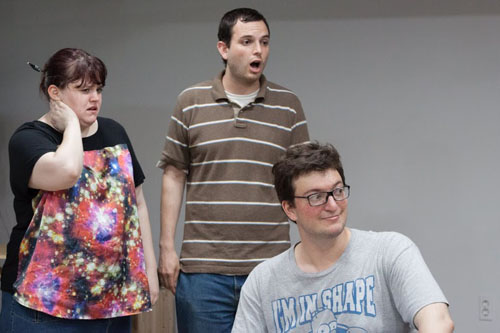
The Gwangju Performance Project, the local amateur performance troupe, is busy preparing this summer’s production of Rumors, a farcical play written by Neil Simon. According to GPP treasurer and cast member Joey Nunez describes, the story is “very line-driven” and “a conversational war between characters.”
The GPP was founded in 2011 by English teachers Travis Major and Jo Park, who have since left Korea. To get a sense of the play, and of the Gwangju community theater, Gwangju News sat down with GPP staff and cast members.
Anna Volle, GPP’s president and director of Rumors, chose this year’s first performance in fall 2013, after the play Why Torture is Wrong and The People Who Love Them received a mixed response.
“The play itself was controversial and not all people who saw the show liked it,” Volle said. “Black humor is hard in any language and it doesn’t always cross borders. But I wanted the new play of the year to be something that everyone could enjoy, something that was light-hearted and fun.”
That’s exactly what “Rumors” is, says Lisa Mynhardt, vice-president of the GPP and the show’s stage manager. “A glimpse into the unbelievable life of the insane upper class, it will get more than a chuckle out of everyone.”
Heather Aitken, who serves as the play’s assistant director as well as GPP secretary, sees the GPP growing into a strong community project. “I want people to know that when we audition, it’s open to anyone in the community. We aren’t a clique. Anyone can be involved. GPP can facilitate joining together the Korean and the foreign communities through the performing arts.”
“I hope that people have a good night out with Rumors and that Koreans can get an insight into American culture.”
Rumors casts a Korean actress into a GPP production for the first time. Susie Choe is a Gwangju native and fourth-year Chonnam National University student. After performing in the Gwangju Vagina Monologues this past April, Choe auditioned for Rumors.
“I didn’t think I could do this, didn’t even think about taking the audition,” Choe said, “because I’m not a native speaker.”
Choe says that while being the only Korean is sometimes a challenge, it doesn’t hold her back fr.om participating. “I don’t feel uncomfortable being with foreigners. The thing I’m worried about the most is bothering other people because of my English ability, but the directors have been so generous to me, so I have no problem so far. And yes I think other Koreans also can get involved if they are willing to. If I can, everyone can! I’m enjoying it, and I just can’t wait to be on the stage!”
Since taking over as GPP president in March, Volle has seen the group expand beyond theater, incorporating a new choir, an emerging dance troupe and monthly theme-based performance workshops.
She cites the recent raffle fundraiser as a successful funding source. “It dramatically changes your options when you have some funding to set things in motion in the first place, being able to fund more larger and daring projects.”
Volle’s dream is for the GPP to become a full-scale Gwangju-based community program.“The Korean community could become involved in a more visible and active way. People who would like to get involved in dance and theater can go to a workshop and learn a little bit and maybe they try auditioning.”
The biggest ambition is making the Gwangju Performance Project an official non-profit organization in Korea. Secretary Nunez said this next step would garner more validity for the project and give more local groups a chance to partner with them.
“What we’re doing now is leaving footprints in the Gwangju community for residents who will be here 5, 10, 15, 20 years from now. Our future looks very bright!”
The Rumors performances are 7pm July 12, 3pm July 13, 2pm + 7pm July 19 and 3pm July 20, at the theater inside the Gwangju Foreign Language Network (GFN) building in Sajik Park. This will be the first performance with accompanying Korean subtitles. GPP membership is 10,000 won per year.
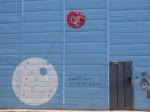
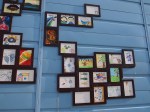
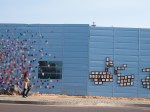
A few months before moving to Gwangju in late April 2013, I paid my first visit to this sixth largest metropolitan city, known as the birthplace of Korean democracy. At the time, and for the following 2 years, the “Blue Wall of Gwangju” was a bright and creative fixture in the middle of the city at the end of that famous street, Geumnam-ro, surrounding the former Jeollanamdo Provincial Hall and the iconic fountain where thousands gathered during the May 18th, 1980 Gwangju Uprising.
As I would soon learn, the Blue Wall, covered in citizens’ murals and children’s artwork and various graffiti, was actually the construction site of the upcoming Asia Culture Center, finally opened in November 2015. Less than a year into my Gwangju residence, I interviewed the man behind the ACC, Chung Dong-chae, for the March 2014 Gwangju News cover story. I learned new-to-me things about the vision of Gwangju that have gradually become a familiar drumbeat: human rights, peace, justice, traditional art, food, culture. I learned that Chung, along with many of the democratic activists and fired journalists under Chun Doo-hwan’s regime, especially those in Gwangju and Jeollanamdo, went into Korea’s political sphere, to raise up their hometown to something beyond what it had been.
The Asia Culture Center is one of the symbols of these development efforts. These days, the Blue Wall is long gone and in its place is a shining, immaculate piece of architecture with large exhibit and conference halls underground, as well as a grassy slope for public gathering aboveground and a clean pavement. The fountain and the Provincial Hall are still there, but banners in Korean and English abound, protesting the alleged erasure of 5.18 history. The ACC took a decade to built and it seems to have been fought, both for and against, every step of the way. Regardless of which side a Gwangju resident stands on, it’s clear that it’s not going anywhere anytime soon.
I feel nostalgic reading this story from three years ago, thinking how little I knew at the time and how much has changed here in Gwangju. How the Blue Wall would not exist without the ACC, and where has all that citizen art gone? I leave my Blue Wall photos here as a representative of my first impressions of Gwangju. I think about the past, present and future of this rugged, complicated, proud city that has become my home.
******
Originally published March 2014 in Gwangju News
Man of Culture: Chung Dong-chae and the East Asia Culture City Forum
It is a big year for Gwangju. The city has held the special status of Cultural Center City in Korea since 2003, but this spring kicks off the 2014 East Asian Cultural City forum, an eight-month celebration and intercultural exchange with two other designated cities – China’s Guanzhou and Japan’s Yokohama.
Signed by the culture ministers of China, Japan and South Korea, the 2012 Shanghai Action Plan represented an unprecedented commitment to overcoming historic regional conflicts in Northeast Asia through strengthening cultural ties. It laid the groundwork for this year’s first annual East Asian Cultural City trilateral exchange.
On September 28, 2013, Gwangju hosted the fifth ministerial conference between the three countries’ culture ministries, who officially nominated Guanzhou, Yokohama and Gwangju as 2014 East Asian Cultural Cities. Gwangju was among six Korean cities, including Busan, Daegu and Jeonju, judged by the culture panel to receive the designation.
On January 27, 2014, Gwangju News sat down with the East Asian Cultural City committee chairman Chung Dong-chae in his office at the Kim Dae-jung Convention Center. He highlighted the fortunate timing of this year’s event, which might build momentum for the opening of another landmark in downtown Gwangju.
“The East Asian Cultural City is important, but I consider it even more important because it can highlight the Asian Cultural City Complex which is opening in 2015,” Chung said. “Even though it wasn’t planned that way, it was a coincidence.”
OLYMPUS DIGITAL CAMERA
OLYMPUS DIGITAL CAMERA
OLYMPUS DIGITAL CAMERA
OLYMPUS DIGITAL CAMERA
OLYMPUS DIGITAL CAMERA
OLYMPUS DIGITAL CAMERA
OLYMPUS DIGITAL CAMERA
OLYMPUS DIGITAL CAMERA
OLYMPUS DIGITAL CAMERA
A Gwangju native, Chung brings to his new role as committee chairman a strong commitment to the city. As the 2004-2006 Minister of Culture, Tourism and Sports, Chung invested in building the Culture Complex as part of the then-evolving Gwangju Cultural City Project.
Chung believes Gwangju is the right choice to be Korea’s East Asian Cultural City. According to him, Gwangju and the larger South Jeolla region are considered to have three characteristics: justice, art (in particular, traditional painting) and food. In addition, he mentions the designation of South Jeolla’s pansori theater as a UNESCO World Heritage item.
“Another characteristic of Gwangju is justice and human rights,” Chung said. “Whenever the nation was in peril, this place was active to save the nation. In the past, when in 1592, the Japanese invasion was here, the most famous admiral Mr. Lee said: ‘Without Jeolla Province, there is no hope.’ Then, under the Japanese occupation of the 20th century, the Gwangju Student Movement spread to the nation as a nationwide independence movement. We also had the Gwangju May Uprising against the military government.”
Beyond his contributions to Gwangju, Chung has played a significant role in revitalizing Korea’s cultural market and promoting mutual communication with neighboring countries.
“While working as minister, I focused on two things: cultural content and tourism development,” Chung said. “I was creating cultural content, including drama, animation, games. At the same time, I made Korea more strong in the world cultural market. I’m proud of that. I also began to develop tourism. Until then, the Korean tourism industry was poor, but I made it develop further.”
Chung’s progression into government service began with a journalism career at Yonhap News (formerly Hapdong News Agency) from the late 1970s. As a journalist under the military regime in 1980, Chung refused to be censored by the government and was removed from his job. “I was imprisoned and tortured as well. So after the transitional government, I was involved in the democratic movement.”
In 1988, Chung joined other fired and repressed journalists to form the Hankyoreh, Korea’s first independent, publicly-funded progressive newspaper. He stayed with the paper until 1993 before moving into politics.
“I was invited by Mr. Kim Dae-jung when he created the Asia Pacific Peace Foundation [in 1994], as a general secretary,” Chung said. “So it was the beginning of my political career.”
Chung served for 2 and a half years in the Asia Pacific Peace Foundation, until the start of Kim Dae-jung’s presidency. He would take up the general secretary position again under Kim’s successor Roh Moo-hyun, who while campaigning for the presidency invited Chung to rejoin the Asia Pacific Peace Foundation board. It was during this campaign that Chung proposed to Roh the idea of the Cultural City project.
“As secretary general under Mr. Roh’s candidacy, I proposed the special law,” Chung said. “As the Minister of Culture, I bought the real estate for the Culture Complex and the construction was initiated. I managed to establish a special law for [Gwangju as] the Cultural City, 2003-2023.”
Before joining the Ministry of Culture and working with President Roh, Chung was elected to the National Assembly in 1996 and was re-elected until he had served three consecutive terms in 2008. “As an Assemblyman, I always was on the committee of Culture and Tourism. That’s why I began to have a lot of interest in culture and tourism so as minister, I implemented what I wanted to do before.”
Chung’s new role as committee chairman is a full-time job. “The East Asian Cultural City was designated in the previous government. In the process of the status of Gwangju to be designated as an Asian Cultural City as well as East Asian cultural City, I was invited to be involved. Now, after the designation, I am working the whole year.”
While Guanzhou and Yokohama’s opening ceremonies were set for February 13 and February 25 respectively, Gwangju will kick off the East Asian Cultural City celebration on March 17.
“In the opening ceremony, Chinese and Japanese performers will be invited and of course we will send our performers to China and Japan,” Chung said. “Forty members of the performance group will come and we will also send forty. People who come to the opening ceremony will enjoy the artwork from China and Japan. The closing ceremonies will take place in October in three countries. There will be a variety of events during this year in all three cities.”
Besides additional smaller events, Chung explained that the 2014 East Asian Cultural City forum will build on three of Gwangju’s most popular annual festivals. “The World Music Festival has included many different countries, but now this time we want to focus on China and Japan. We will have an extended Arirang festival and the Chungjang-ro festival will have performers from China and Japan as well. That festival has been designated by the national government. The central government is also advising the existing festival to be more East Asian.”
Since the announcement of the 2014 East Asian Cultural Cities, Chung has seen cross-cultural interest grow, with Korea showing more interest in Chinese and Japanese culture and China and Japan expressing a growing appreciation for what Gwangju has to offer. “After the designation, the interest of Gwangju city has grown, both in China and Japan. The mass media began to show interest in Gwangju.”
In 2007, the ministers of the three major East Asian countries launched annual ministerial conferences to focus on building what China’s Minister of Culture Cai Wu has called a “shared East Asia value” that could bring better cooperation and stability to the region. The Shanghai Action plan was signed in the year that marked the 40th anniversary of normalized China-Japan diplomatic relations and the 20th anniversary of China-South Korea diplomacy. The next minister trilateral meeting takes place in Yokohama in September 2014. Through 2017, each country will continue annually selecting a representative East Asian Cultural City.
“Two years ago, we decided to do it with the Shanghai Action Plan, but this is the first year we are doing it and it will continue,” Chung said. “The Cultural City Project will continue, more cities will be invited to join. Through this project, I hope that more cultural understanding will be created with other countries, and a promotion of understanding that will help the conflict.”





 Love Letters to the Present